AEO for engineering teams: making pages readable to AI answer engines
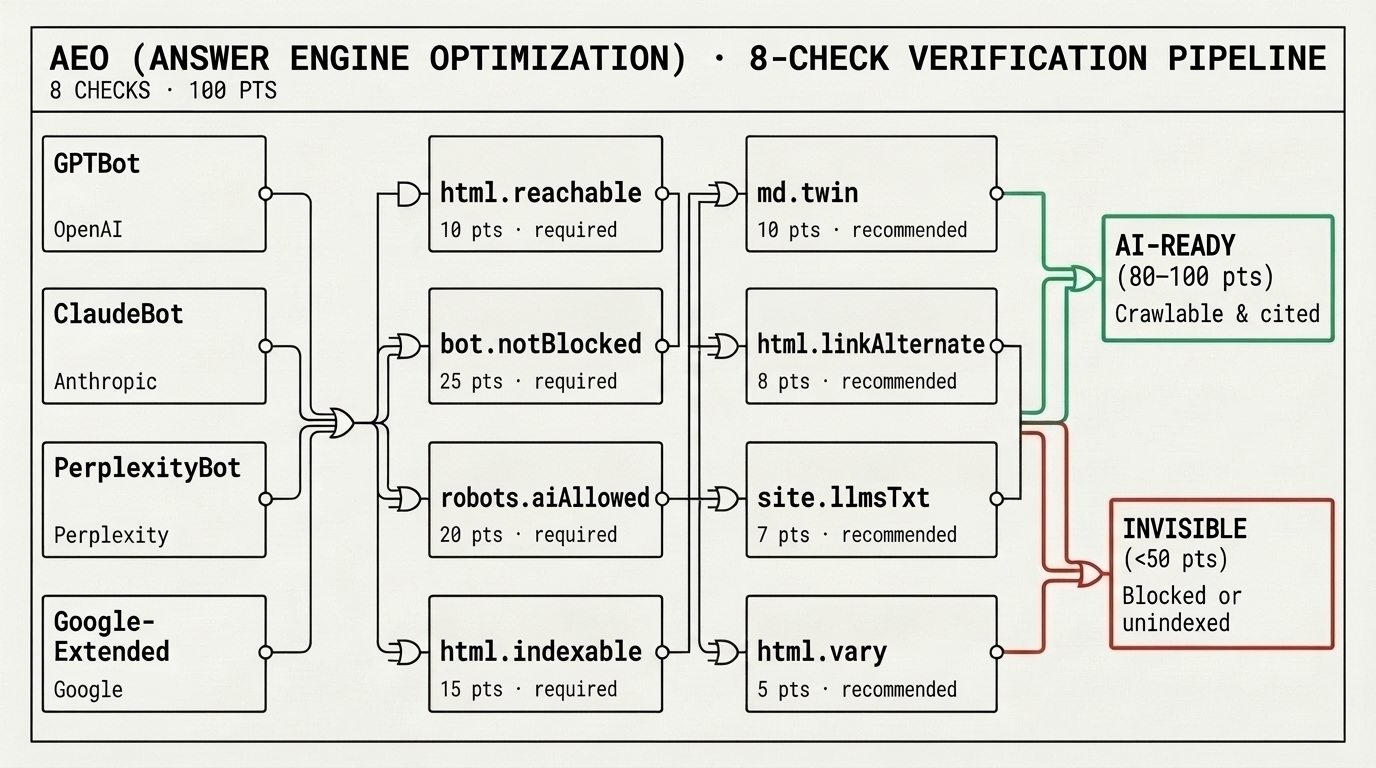
A landing page can score 0 out of 100 on the design-slop fingerprint and still be completely invisible when a buyer asks an AI assistant to compare tools in your category. Answer Engine Optimization (AEO) measures whether automated research agents can fetch, parse, and cite your canonical content over HTTP.
The eight-check verification circuit
The AEO axis evaluates eight concrete HTTP and HTML signals totaling 100 points (70 required points + 30 recommended bonus points):
html.reachable(10 pts, required): verifies that normal browser HTTP fetch returns a 2xx HTML document.bot.notBlocked(25 pts, required): confirms that fetching with theGPTBotUser-Agent returns 2xx rather than a WAF challenge or 403 block.robots.aiAllowed(20 pts, required): verifies thatrobots.txtdoes not disallow major AI crawlers (GPTBot,ClaudeBot,PerplexityBot,Google-Extended).html.indexable(15 pts, required): confirms the page does not emitnoindexinX-Robots-Tagheaders or<meta name="robots">.md.twin(10 pts, recommended): checks for a clean<url>.mdmarkdown twin (or/index.mdfor the root path) returningtext/markdown.html.linkAlternate(8 pts, recommended): checks that HTML advertises the markdown twin viaLink: rel="alternate"; type="text/markdown"or<link rel="alternate">.site.llmsTxt(7 pts, recommended): checks for a structured/llms.txtdiscovery file at the root domain.html.vary(5 pts, recommended): checks that the response sendsVary: Acceptfor content-negotiation awareness.
Serving markdown twins
Every documentation and blog route on slop-detect.com exposes a direct markdown twin alongside its HTML page. Run npx slop-detect <url> --aeo or POST /api/aeo to audit any URL against all eight checks.