Calibrating the four-axis instrument: design, copy, system, and AEO
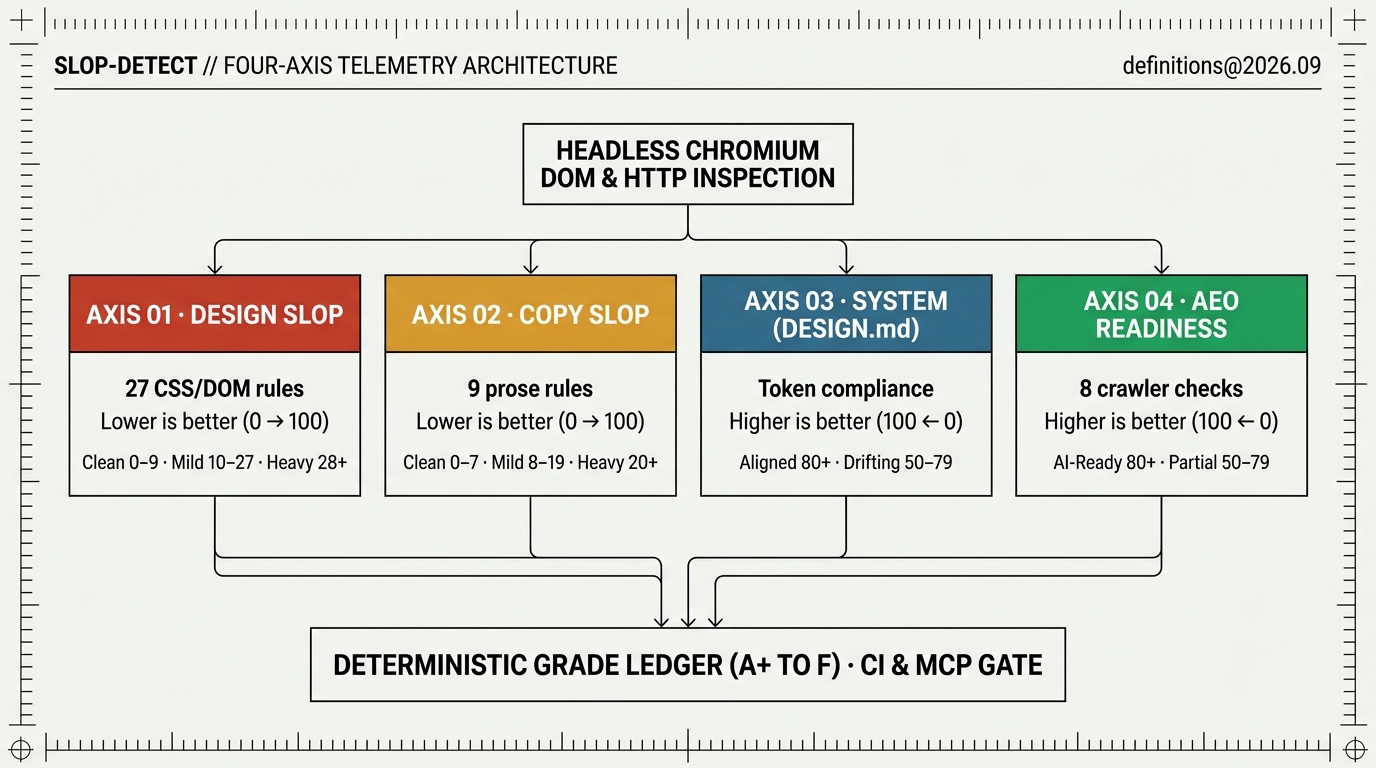
A single visual score catches template reflexes, but modern web software fails in four distinct ways. A landing page can wear a generated layout, speak in repetitive machine prose, drift off its team's declared design tokens, or ship an empty client-rendered shell that AI answer engines cannot read.
Four independent axes with explicit polarity
In definitions 2026.09, the engine separates these concerns into four orthogonal axes:
- Design slop: 27 weighted CSS and DOM checks run in real headless Chromium. Lower is cleaner (0 to 9 Clean, 10 to 27 Mild, 28 and up Heavy).
- Copy slop: 9 prose checks run against extracted page text at zero extra navigation cost. Lower is cleaner (0 to 7 Clean, 8 to 19 Mild, 20 and up Heavy).
- System compliance (DESIGN.md): relative verification against the repository's own declared colors, typography, and corner radii. Higher is better (80 to 100 Aligned, 50 to 79 Drifting, below 50 Off-system).
- AEO readiness: 8 crawler and content-negotiation checks verifying whether answer engines can index and cite the page. Higher is better (80 to 100 AI-Ready).
Inspecting DOM strata in 3D
When a page triggers multiple design or layout rules, reading a flat list of rule IDs hides where the tells live in the document tree. The interactive 3D DOM spectrometer on the home page and per-domain score hubs explodes the scanned document into five vertical strata: typography, palette and contrast, layout topology, copy rhetoric, and AEO metadata.
npx slop-detect https://your-site.com --axes all --design-md auto --aeoClosing the loop in CI and MCP
Because every check is a deterministic function of computed styles and HTTP headers, coding agents can call slop-detect-mcp inside the editor before opening a pull request, and teams can gate deploy previews with slop-detect-action in GitHub Actions.