/compare · head-to-head & methodology
How Slop Detector compares
Compare any two domains side by side on the published 2026.10 leaderboard. The live engine is definitions 2026.11 and those rows have not been re-scored. The score is a fixed catalogue evaluated in Chromium.
Head-to-head fingerprint comparison
One fixed yardstick, not a moving model
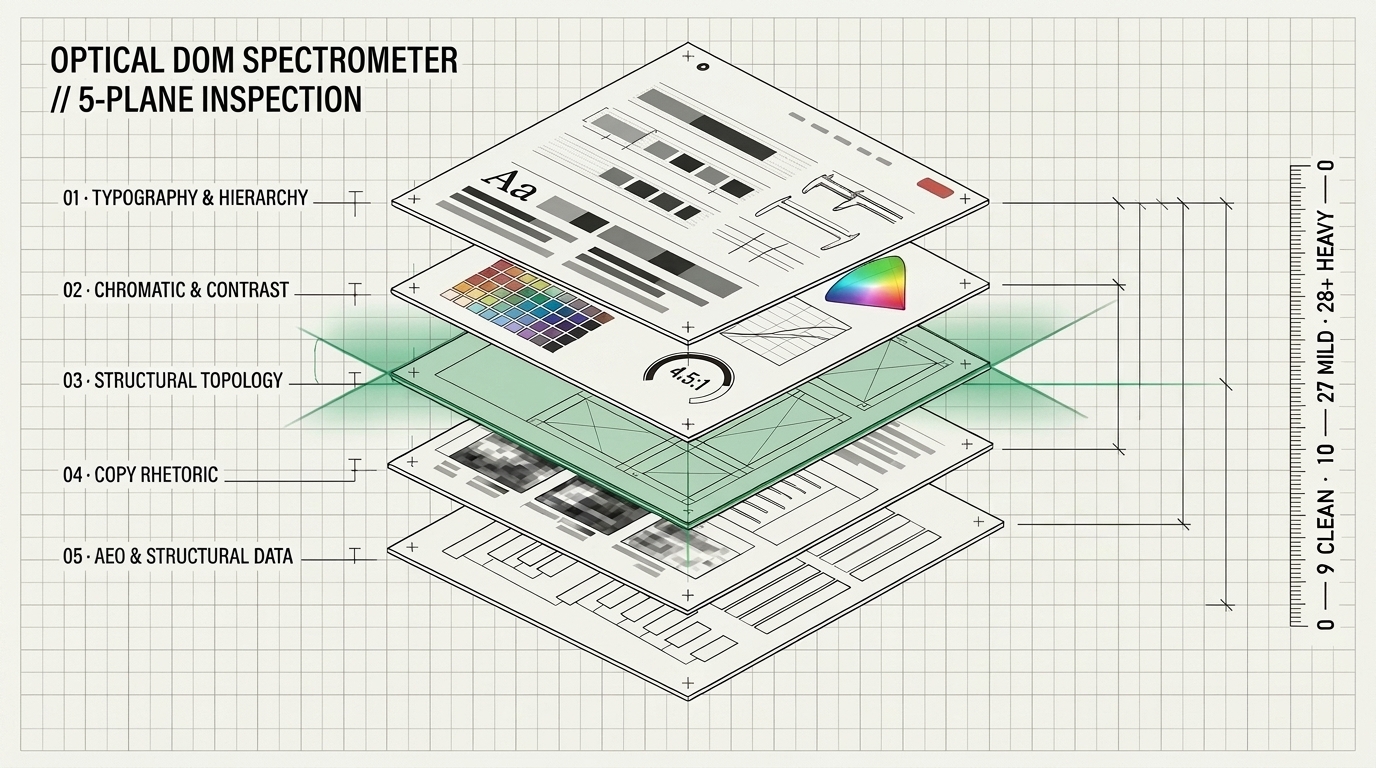
Most "is this AI?" tools are probabilistic ML classifiers: they output a confidence that something was machine-generated, and that confidence shifts as the model is retrained. Slop Detector works the other way. It is a deterministic fingerprint: a fixed catalogue of CSS and copy tells, each with a fixed weight, evaluated against a page's live computed styles in real headless Chromium. The same page always yields the same score. No model, no randomness, so the output is auditable, reproducible, and safe to gate CI on.
How the approaches differ
| Dimension | Slop Detector | Typical ML AI-detectors | Generic Lighthouse / a11y |
|---|---|---|---|
| Output | Deterministic 0–100 weighted fingerprint | Probabilistic % confidence | Perf / a11y / SEO scores |
| Reproducible | Yes, same page, same score | No, drifts with retraining | Mostly |
| What it measures | AI-design + copy slop tells | Generated-vs-human likelihood | Technical quality, not aesthetics |
| Engine | Real Chromium, computed styles | Text / pixel models | Real Chromium |
| Auditable rules | Yes, open catalogue at /api/patterns | Opaque weights | Documented audits |
| AEO axis (AI-readability) | Yes, built in | No | Partial (SEO only) |
| License | Open source (MIT) | Usually closed | Mixed |
| Agent interfaces | API + CLI + MCP | Rare | Rare |
What a fixed score buys you
- CI gating. Fail a build at
--fail-on heavyand trust the threshold won't move under you. - Auditability. Every point in a score traces to a named pattern with a documented weight.
- Comparability. Two designs measured on the same fixed yardstick, today and next year.
- No false confidence. A high score says "this matches many default-template patterns," not "an AI wrote this." A fingerprint, not a verdict.
Where the weights come from
The pattern weights derive from Adrian Krebs's April 2026 study
of 1,400 Show HN submissions, plus Meng To's
default-template observations. The catalogue is versioned (DEFINITIONS_VERSION) and served
live at /api/patterns.
Pick by the question you're asking
- Slop Detector: a reproducible, explainable read on how many default-template patterns a landing page matches, or to gate design regressions in CI.
- An ML AI-detector: a probabilistic "was this generated?" verdict on arbitrary text or images.
- Lighthouse / axe: performance, accessibility, and technical SEO. Orthogonal to slop.
Run a scan
Web: slop-detect.com ·
CLI: npx slop-detect <url> ·
MCP: slop-detect-mcp ·
API: /openapi.json ·
Source: GitHub